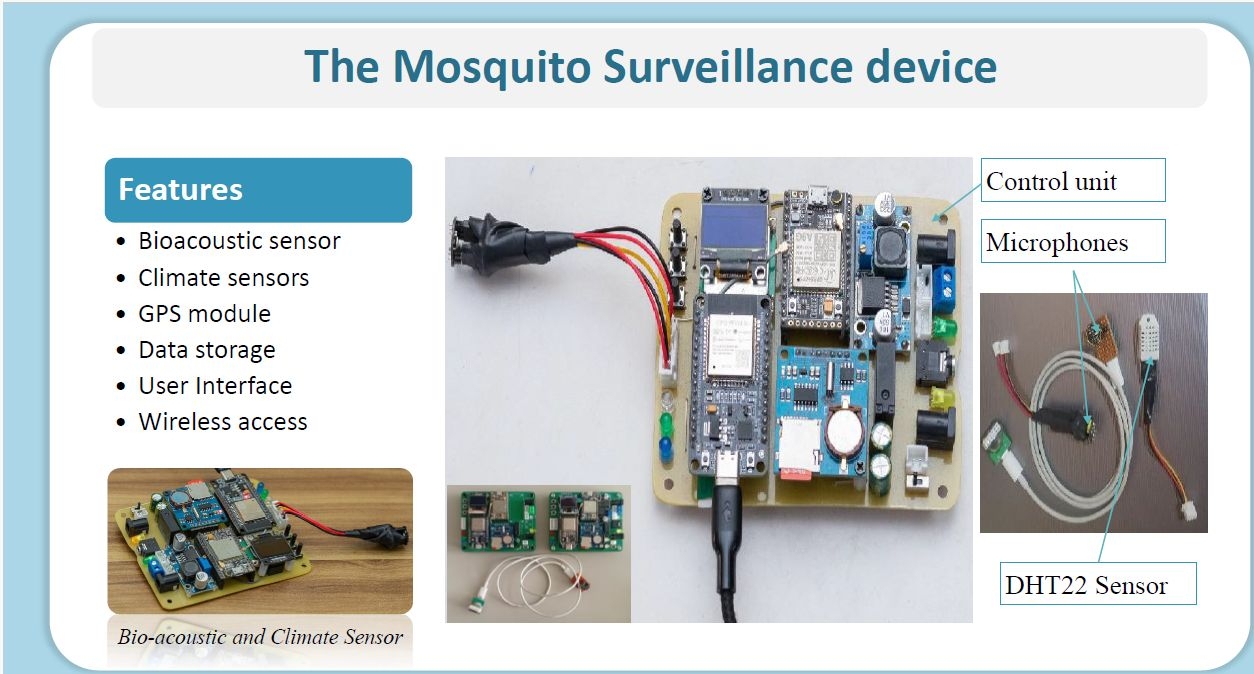
Researchers at the College of Science, KNUST have developed a low-cost mosquito surveillance system capable of detecting mosquito sounds in real time while recording environmental conditions, a breakthrough that could strengthen disease monitoring in resource-limited regions.
The system, named MosquitoTrack, was able to accurately identify mosquito sounds under varying environmental conditions, demonstrating its potential as a practical tool for tracking mosquitoes linked to diseases such as malaria and dengue.
The study comprised of a multidisciplinary team from the Departments of Physics, Computer Science, Meteorology and Climate Science, and Theoretical and Applied Biology at KNUST, in collaboration with the Ghana Health Service and the University of Toronto.
According to the researchers, mosquito-borne diseases continue to cause hundreds of thousands of deaths globally each year, with sub-Saharan Africa recording the highest burden. Existing mosquito monitoring systems are often expensive, labour-intensive and difficult to use continuously in remote communities.
To address this challenge, the KNUST team designed MosquitoTrack as a compact and portable device that can record mosquito sounds together with environmental information such as temperature, humidity and location.
Unlike many existing surveillance systems that rely heavily on internet connectivity, Mosquito Track can function offline and store information directly on the device. It also includes a built-in web platform that allows users to access recordings, monitor environmental conditions and manage files using Wi-Fi-enabled devices.
Laboratory testing showed the system could reliably capture mosquito sounds under different environmental conditions. Researchers tested both single and grouped mosquitoes to evaluate the device’s ability to detect varying sound patterns.
The researchers noted that advanced noise reduction techniques significantly improved the clarity of mosquito sounds captured by the device, making it easier to isolate mosquito activity from surrounding background noise.
According to the team, the affordability, portability and offline capability of MosquitoTrack make it particularly suitable for mosquito surveillance in rural and underserved communities. They added that the device could support mobile health initiatives, citizen science projects and educational programmes by enabling communities to participate in mosquito monitoring and vector control activities.
Future work will focus on field deployment, solar-powered operation and the integration of artificial intelligence tools that can automatically identify mosquito species in real time.
The study was supported by the RAPiD VBP project, for which Prof. Kingsley Badu is the Principal Investigator, and funded by Canada’s International Development Research Centre.
Authors of the study comprise of Nutifafa Yao Agbenor-Efunam, Akyana Britwum, Michael Kweku Edem Donkor, Rose-Mary Owusuaa Mensah Gyening, Alice Bagyiereyele Lakyiere, Edmund Ilimoan Yamba, Franklin Asiedu-Bekoe, Jude Dzevela Kong and Kingsley Badu.