The problem arrived, as it often does in Ghana, with the hum of silence; the moment the power cuts out, the fans stop spinning, and the lights go dark. Dumsor, Ghanaians call it. The cycle of power outages that has shadowed the country's development for decades.
For most people, it is an inconvenience. For a farmer hauling tomatoes and other perishable items from Kumasi to Accra in the back of an unrefrigerated truck, it can mean the difference between profit and ruin.
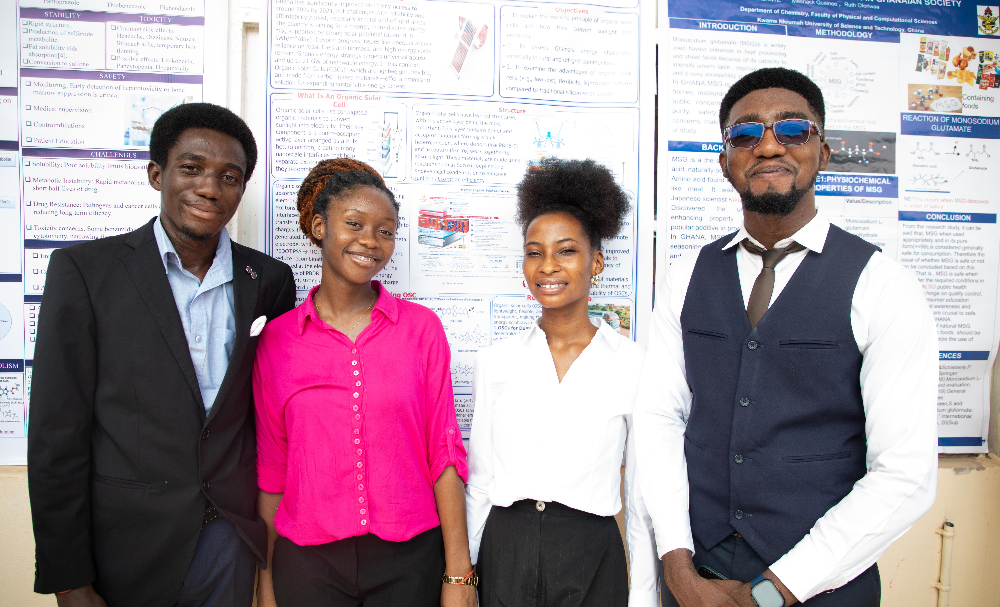
Four second-year chemistry students at the College of Science, KNUST have found a piece of the answer, not in silicon panels bolted to rooftops, but in a new generation of ultra-thin, flexible, see-through solar cells made from carbon-based organic materials.
A Solar Cell You Can See Through
Their research poster, pinned to a wall among dozens of semester projects at the Department of Chemistry, carries an ambitious title: "Using Organic Solar Cells (Organic Photovoltaic Cells) to Solve Ghana's Energy Problem."
The authors including Opoku-Esie John Paul, Saraswati Ampong, Amankwah Sarah, and Daniel Nii-Attey Tawiah are chemistry undergraduates, not yet two years into their degrees. But you would not know it from the science.
Unlike conventional solar panels, the heavy, rigid, blue-black rectangles becoming a familiar sight on Ghanaian rooftops, organic solar cells (OSCs) are lightweight, semi-transparent, and flexible.
They can be layered onto surfaces like window glass or wrapped around curved structures. And critically for a country where cost remains a stubborn barrier to energy access, they hold the promise of being significantly cheaper to manufacture.
"Because of its flexibility, lightweight and transparency, we can use it in windows. The sun falls directly on it, and it produces electricity, " they explained
Keeping Crops Cool Between Kumasi and Accra
The science is elegant. But it is the application that gives the project its urgency.
Ghana loses a significant portion of its agricultural produce to spoilage during transport. Tomatoes, vegetables, and other perishables travel hundreds of kilometers in the heat, often arriving at markets partly rotten. Cold chain infrastructure, the network of refrigerated vehicles and storage facilities that wealthy economies take for granted, remains sparse and expensive.
The students envision organic solar panels laminated directly onto transport vehicles, powering small refrigeration units without adding meaningful weight or fuel cost.
"We don't increase the fuel cost of the car," one of the students said. "We are able to use it to produce a refrigerator, which is going to conserve the crops being transported from Kumasi to Accra."
It is a modest proposal with an outsized implication: solar-powered cold chains that require no grid connection, no diesel generator, and no heavy infrastructure investment.
Windows That Generate Electricity, Phone Covers That Charge Your Phone
The agricultural application is only one thread in a broader vision the students have stitched together.
Because organic solar cells are semi-transparent, they can be integrated into window glass on buildings, schools, clinics, and offices allowing structures to generate electricity from the same panes that let in light.
The students also floated an idea that is distinctly of their generation: embedding organic solar cells into phone covers, turning a ubiquitous consumer accessory into a trickle charger.
For four second-year students in Kumasi, the question is not whether the technology will mature. It is whether Ghana will be ready to use it when it does.
Their poster, numbered 39 and pinned beside dozens of others, offers a quiet argument that the thinking at least is already underway.