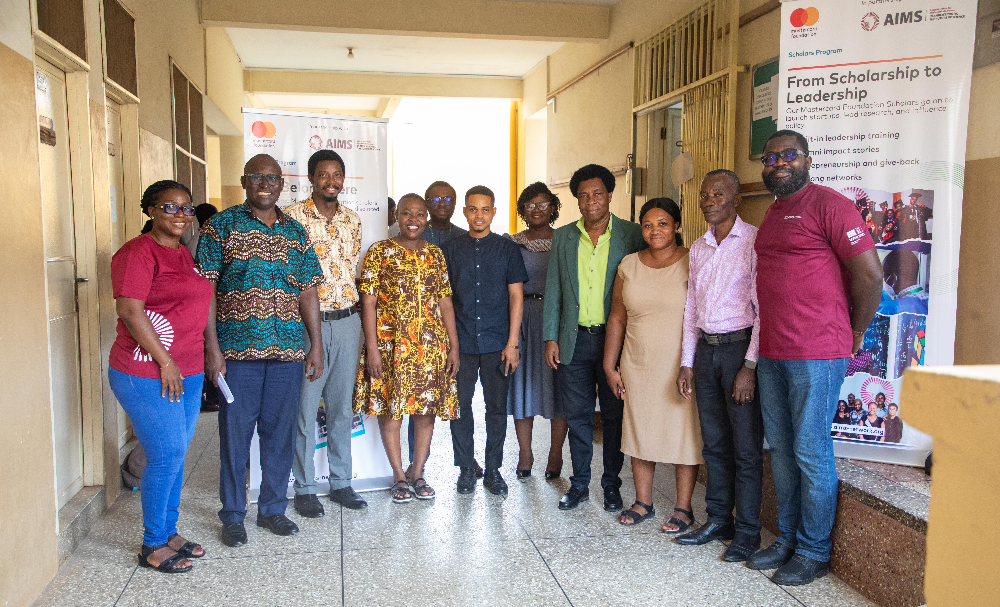
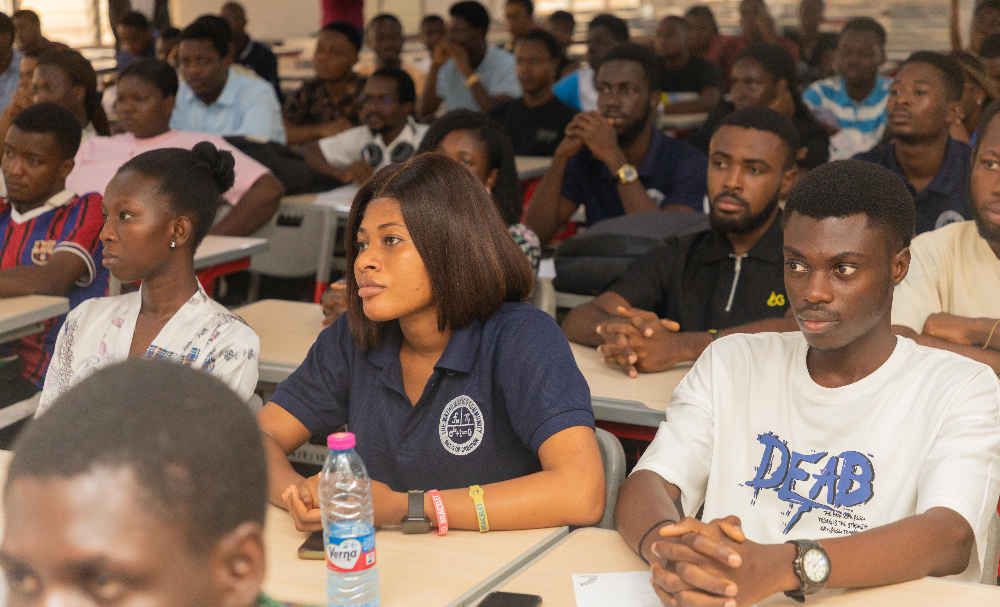
The Department of Mathematics, Statistics and Actuarial Science at the College of Science, KNUST has hosted a recruitment and information session by the African Institute for Mathematical Sciences (AIMS) to introduce students to postgraduate opportunities in mathematical sciences across Africa.
The engagement brought together students to learn more about advanced training and scholarship opportunities offered by the AIMS network, which operates centres in South Africa, Senegal, Cameroon, Ghana and Rwanda.
In his welcome address, Prof. Charles Sebil, Head of the Department of Mathematics, Actuarial Science and Statistics at KNUST, welcomed the AIMS delegation and encouraged students to take advantage of opportunities that could further strengthen their academic and professional development in mathematical sciences.
Providing an overview of the session, Mr. John Appiah, Senior Manager at the AIMS Network, highlighted the institute’s mission of developing Africa’s brightest mathematical talents through postgraduate education, research and public engagement initiatives across the continent.
Mrs. Beauty Beatrice Kwawu, Programs Manager at AIMS Ghana, explained that the visit formed part of AIMS’ public engagement activities aimed at informing students about its programs and encouraging qualified graduates to apply.
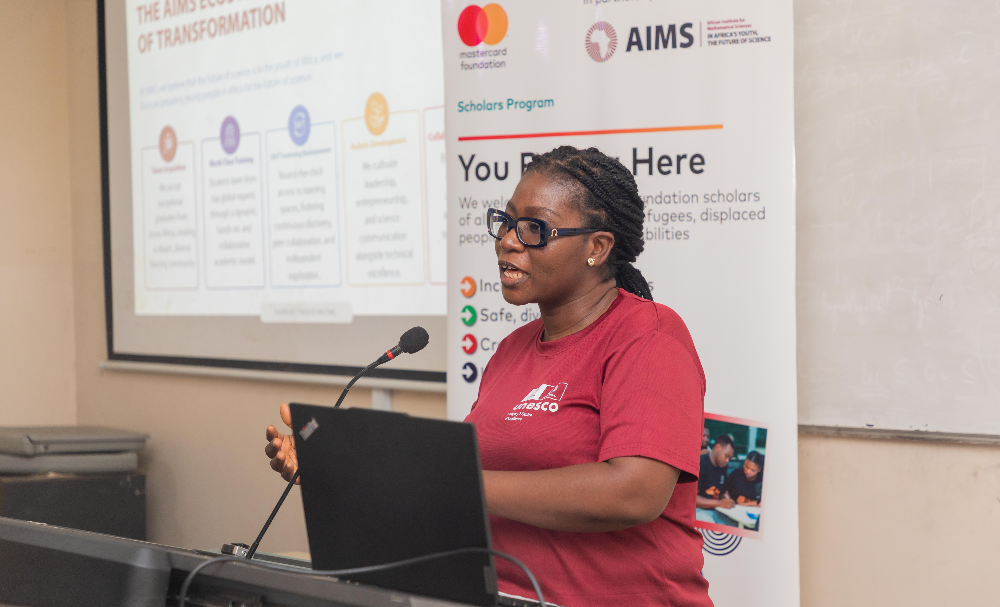
Mrs. Kwawu noted that the AIMS network currently operates six centres across Africa, including centres in South Africa, Senegal, Cameroon, Ghana and two centres in Rwanda, one of which is dedicated to advanced research including PhD and postdoctoral programmes.
She explained that AIMS offers world-class postgraduate training through an intensive residential learning environment where students receive instruction from international faculty drawn from universities across Africa, Europe and the United States.
“At AIMS, we focus not only on academic training but also on holistic development,” she explained. “Students receive career training, leadership development and well-being support to prepare them to become leaders who contribute to Africa’s development.”
Mrs. Kwawu highlighted several academic programmes available across the AIMS network, including the Structured Master’s Programme in Mathematical Sciences, a 10-month intensive programme, and the Cooperative Education (Co-op) Programme, which combines academic study with work-integrated learning to prepare graduates for industry and entrepreneurship.
Other specialised programmes within the network include Artificial Intelligence for Science offered in South Africa and a Master’s programme in Mathematical Epidemiology offered in Cameroon and Rwanda.
At AIMS Ghana, she noted, three main academic programmes are offered: the Structured Master’s programme, the Co-op programme and the Master’s in Mathematical Sciences for Teachers, which aims to strengthen the pedagogical skills of mathematics teachers at the secondary school level.
According to Mrs. Kwawu, AIMS Ghana admits about 60 students annually into the regular master’s programme, 35 into the co-op programme and at least 100 students into the Mathematical Sciences for Teachers programme, drawing students from across Africa. Currently, the Ghana centre hosts students from 19 countries.
She further indicated that the AIMS network has produced over 3,000 alumni across its centres, with about 58 percent progressing to doctoral studies while others pursue careers in industry, research and entrepreneurship. Approximately 86 percent of graduates remain in Africa, contributing to research and development across the continent.

During the session, Dr. Bernard Oduku Banson, an AIMS Ghana alumnus and former Academic Manager, explained the structure of the institute’s academic programmes and shared insights on how prospective applicants can prepare strong applications.
AIMS alumni also shared their experiences and discussed career pathways available after completing the programme, including opportunities in academia, industry and entrepreneurship.
Students were also encouraged to take advantage of the application window currently open for prospective candidates. Applicants must hold an undergraduate degree in a science-related field with a strong mathematical component and demonstrate leadership potential and commitment to community engagement.
Ms. Kwawu also encouraged more female students to apply as part of efforts to address gender disparities in advanced mathematical sciences, noting that applicants from underrepresented groups, including refugees, displaced persons and persons with disabilities, are given special consideration.
The session concluded with an interactive question-and-answer segment led by the AIMS Ghana team, providing students with guidance on application procedures, deadlines and available support mechanisms.