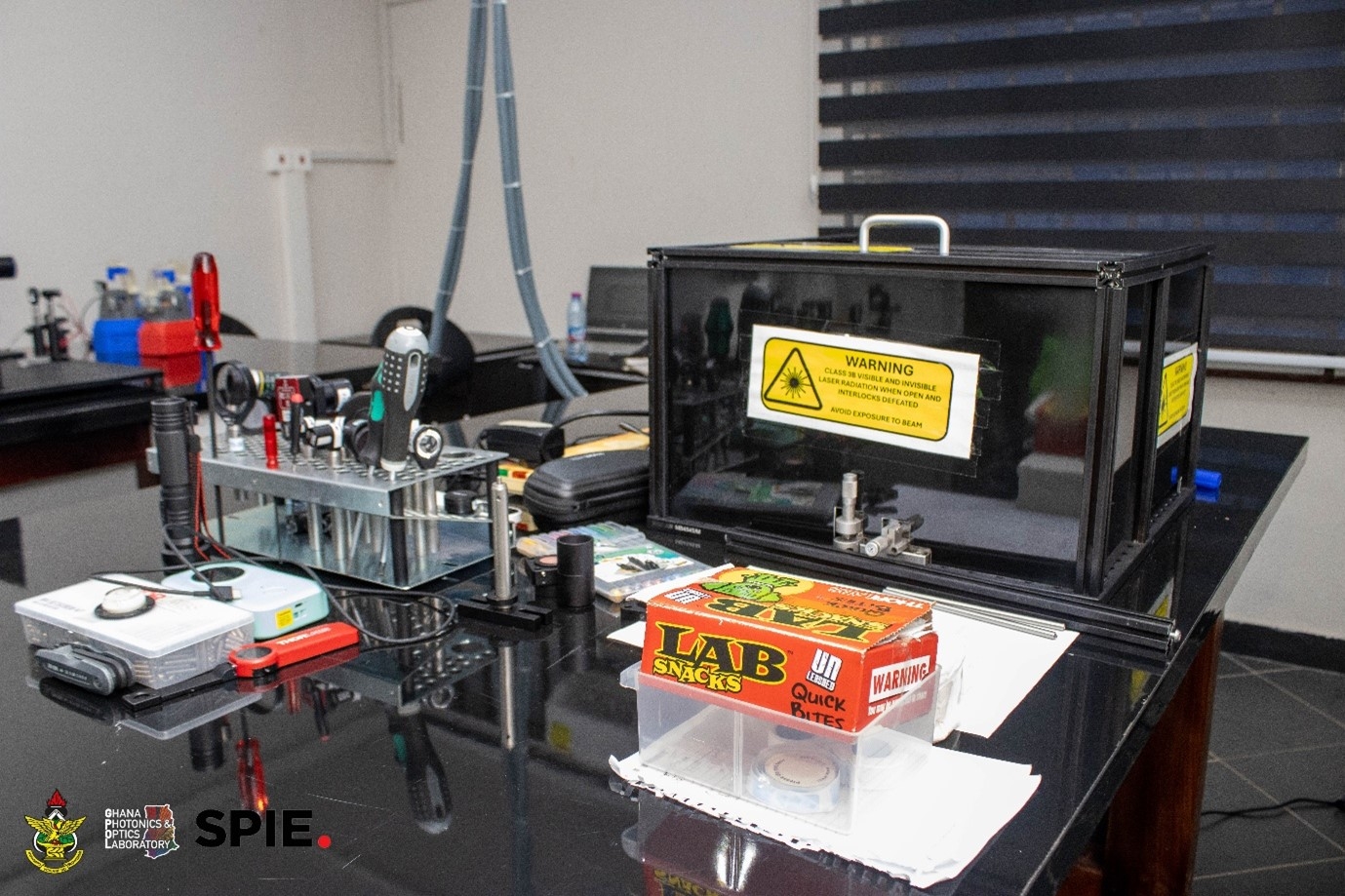
The Ghana Photonics & Optics Laboratory (GPOL) under the Department of Physics at Kwame Nkrumah University of Science and Technology, (KNUST) has received a state-of-the-art Through-Barrier Raman Spectrometer aimed at detecting counterfeit alcoholic beverages and pharmaceuticals without opening sealed containers.
The acquisition, made in partnership with University of St Andrews, was announced during a colloquium delivered by Dr. George O. Dwapanyin on the topic, “Looking Through the Glass: Raman Spectroscopy of Concealed Samples in Sealed Containers Using Shaped Laser Light.”
The custom-built system, assembled by Dr. Dwapanyin and his research team at the University of St Andrews led by Dr. Graham Bruce and Prof. Kishan Dholakia, uses shaped laser light and advanced Raman spectroscopy techniques to identify the chemical composition of substances hidden behind glass or plastic barriers, making it possible to detect fake products, methanol contamination, and adulteration without tampering with packaging.
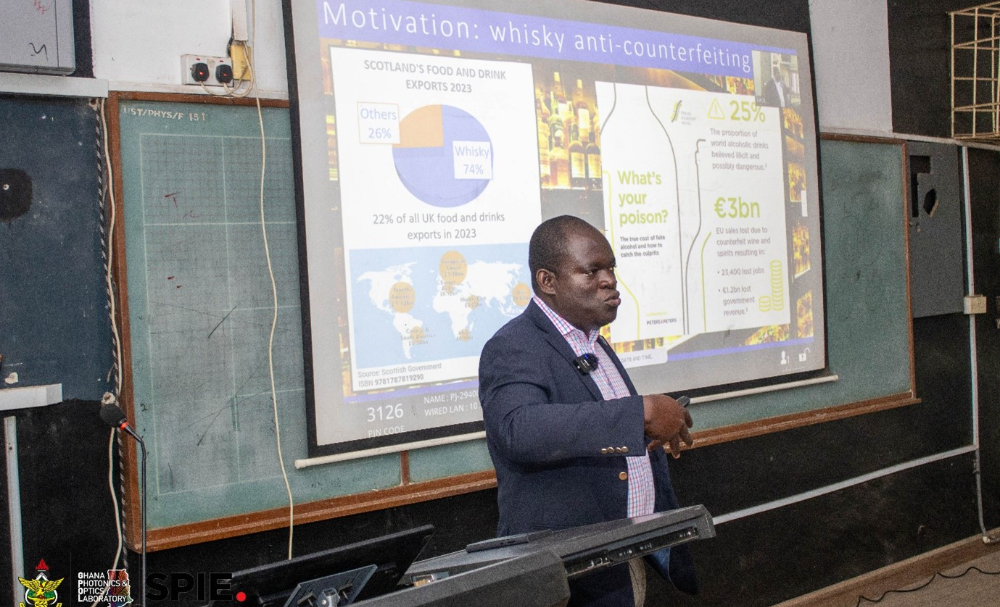
Speaking during the presentation, Dr. Dwapanyin highlighted the growing global challenge of counterfeit alcohol and methanol poisoning, particularly within the food and beverage industry.
“You cannot go around opening expensive bottles of whiskey just to test them. There was the need to find a way to ensure quality standards and detect adulteration without having to open the package,” he stated.
He explained that the technology explores the interaction between light and molecules to generate unique “fingerprints” for different substances.
“With Raman spectroscopy, every molecule has a unique fingerprint. Once you determine those vibrational modes, you can identify what is contained inside the bottle,” he said.
According to him, conventional Raman systems often struggle to analyze bottled substances because signals from the container interfere with the actual content.
To overcome this, his team developed a specialized “through-bottle” configuration using Focus-matched Inverse Spatially Offset Raman spectroscopy (FM-iSORS) and shaped Bessel laser beams capable of suppressing signals from the container while enhancing signals from the liquid inside.
The system demonstrated the ability to distinguish between authentic and counterfeit whiskey brands with up to 97 percent classification accuracy and could detect methanol concentrations as low as 0.5 percent, well below international safety thresholds.
Dr. Dwapanyin revealed that the technology has already attracted interest from major international beverage producers and research centres, including Scotch Whiskey Research Institute, over concerns about counterfeit products damaging brand reputation.
“If someone puts a cheap drink into an expensive bottle, the system is still able to identify it,” he noted.
Beyond alcoholic beverages, he added that the technology is also being explored for pharmaceutical authentication. He cited the increasing circulation of counterfeit medicines in sub-Saharan Africa and the dangers posed by fake anti-malaria drugs, antibiotics and opioid substances to public health
“You cannot always take medicines to the lab and destroy them for testing. We started thinking that this technology could have a life-saving application beyond beverages,” he said.
The new spectrometer at GPOL can also be used in other scientific areas such as environmental science, food science and security, material science among others and is expected to support research, innovation, and industrial quality assurance while strengthening Ghana’s scientific capacity in photonics, optics, and advanced chemical sensing technologies.