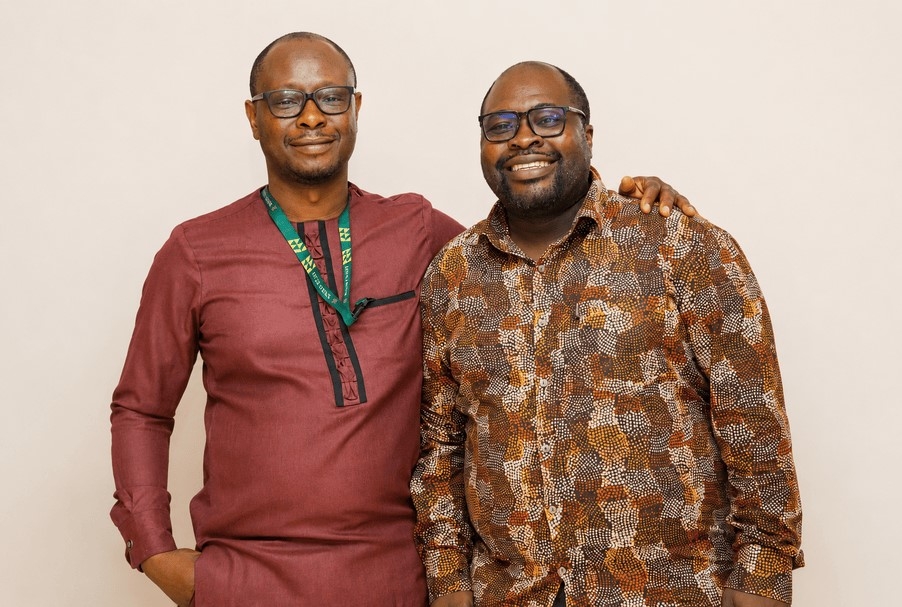
Researchers from the Department of Physics at the College of Science, KNUST, Dr. Akyana Britwum and Dr. Michael Kweku Edem Donkor, have secured funding from the United Kingdom Research and Innovation (UKRI) through the Science and Technology Facilities Council (STFC) to strengthen photonics research and training in West Africa.
The project, titled “Building Opportunities via Spectroscopy, Optics and Microscopy Training for West-African Empowerment (BOSOMTWE)”, is being implemented through a UK-Ghana partnership led by KNUST and the University of St Andrews. The initiative forms part of efforts to expand access to advanced optical technologies and scientific training across the region.
Under the project, the Ghana Photonics and Optics Laboratory (GPOL) at KNUST will receive two custom-built optical systems: a compact super-resolution microscope capable of imaging biological structures and materials at the nanoscale, and a through-barrier Raman spectrometer that can be used to identify substandard and falsified medicines and food products without opening their packaging.
The project will also establish laser safety policies and training programmes, creating a foundation for the safe use of advanced photonics technologies in Ghana and the wider West African region.
Photonics, the science of generating, controlling and detecting light, is increasingly important in healthcare, communications, manufacturing, security, agriculture and environmental monitoring.
By expanding access to advanced spectroscopy, optics and microscopy facilities, the project is expected to create new opportunities for scientific research, innovation and postgraduate training at KNUST.
Project partners include Dr. Graham Bruce, Dr. George Dwapanyin and Dr. John Daniel of the University of St Andrews, Dr. Thelma Ohene-Agyei of the University of Ghana, and Aurora Health Physics Services Limited.
The grant further strengthens KNUST's position as a growing hub for photonics research and advanced scientific instrumentation in Africa.