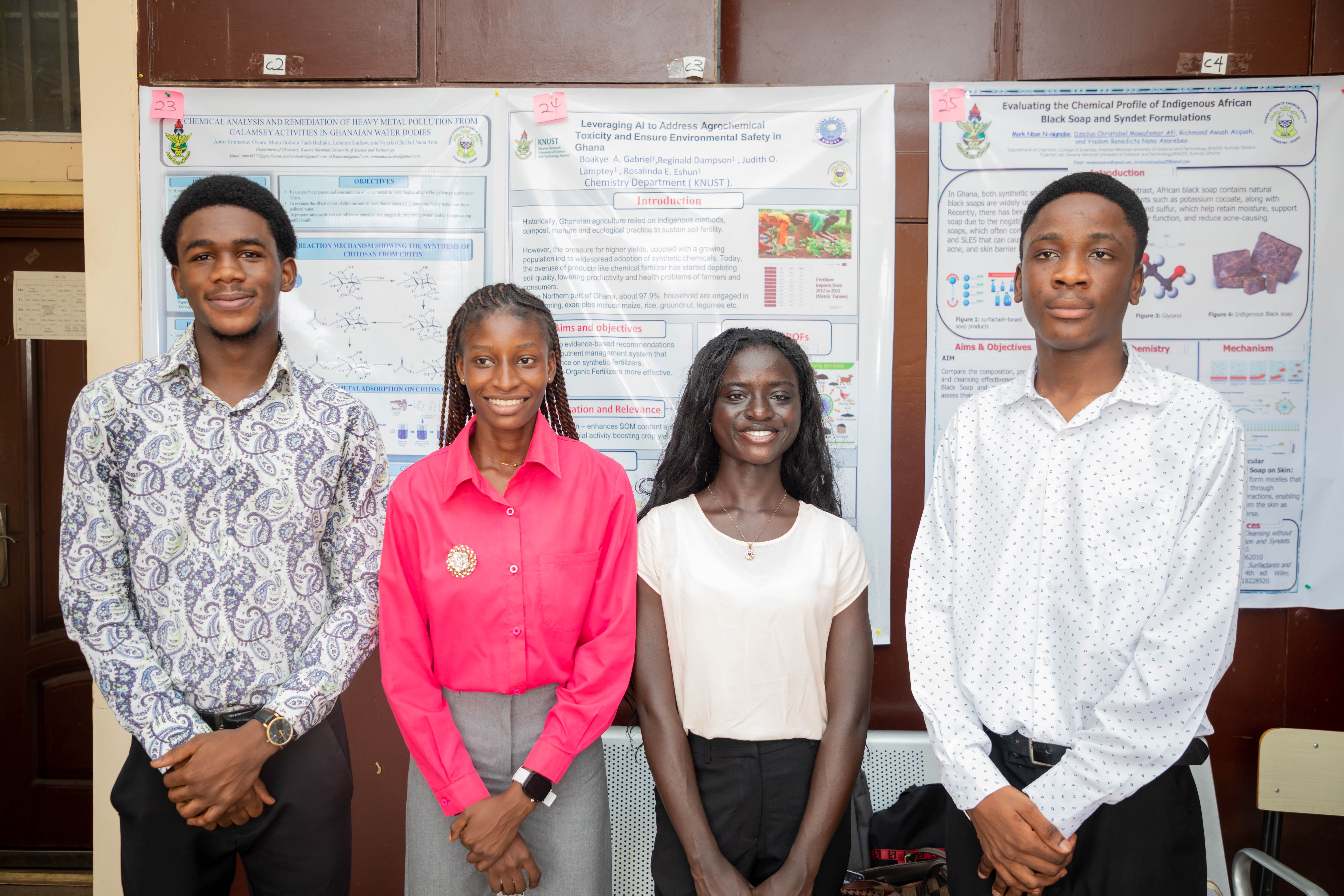
Under the bright light of a poster exhibition at the Department of Chemistry, KNUST, a group of students stood beside their work, tackling a problem that stretches far beyond the walls of their lecture halls: how to feed a growing nation without damaging the land that sustains it.
Their poster, titled "Leveraging AI to Address Agrochemical Toxicity and Ensure Environmental Safety in Ghana," explores how artificial intelligence could help farmers strike a delicate balance between productivity and environmental protection.
For generations, Ghanaian farmers depended on organic methods including compost, manure, and ecological practices to maintain soil fertility. But as population growth intensified the demand for food, synthetic fertilizers became the faster, more convenient option.
That shift, the students explain, has come at a cost.
"Soil acidification, nutrient leaching, and environmental pollution are some of the side effects we are seeing," Reginald Dampson noted, pointing to sections of the poster outlining the risks. "It also affects the health of farmers and consumers."
The problem is especially significant in northern Ghana, where agriculture is a primary livelihood and the pressure to increase yields is high.
Rather than calling for a complete return to organic farming, the students are proposing a middle ground, one powered by technology.
Their solution centres on combining bio-organic and synthetic fertilizers, but with a critical twist: using artificial intelligence to determine the right proportions for each soil type and condition.
"It's not about choosing one over the other," Boakye A. Gabriel explained. "It's about using AI to guide us on how best to combine them safely and effectively."
Through this approach, farmers would be able to apply only the exact amount of fertilizer needed, reducing waste, limiting environmental damage, and maintaining soil health.
To make this possible, the students propose integrating near-infrared (NIR) spectroscopy, a technology capable of rapidly analyzing soil composition. When paired with blockchain systems, the tool could provide real-time, reliable data on soil nutrient levels, helping farmers make immediate and informed decisions.
The result, they say, is a "smart hybrid fertilizer" system that merges the strengths of both organic and synthetic inputs while minimizing their weaknesses.
Their project also highlights the limitations of relying solely on bio-organic fertilizers, noting that while they are environmentally friendly, they may not always meet the yield demands of modern agriculture on their own.
Instead, the future lies in precision.
From algorithm-driven fertilizer design to data-informed farming practices, the students envision a system where decisions are no longer based on guesswork, but on science and real-time analysis.
They believe technology, when applied thoughtfully, could help Ghana grow more food without sacrificing the health of its soils or ecosystems.
The project was carried out by Boakye A. Gabriel, Reginald Dampson, Judith O. Lamptey, and Rosalinda E. Eshun of the Department of Chemistry.