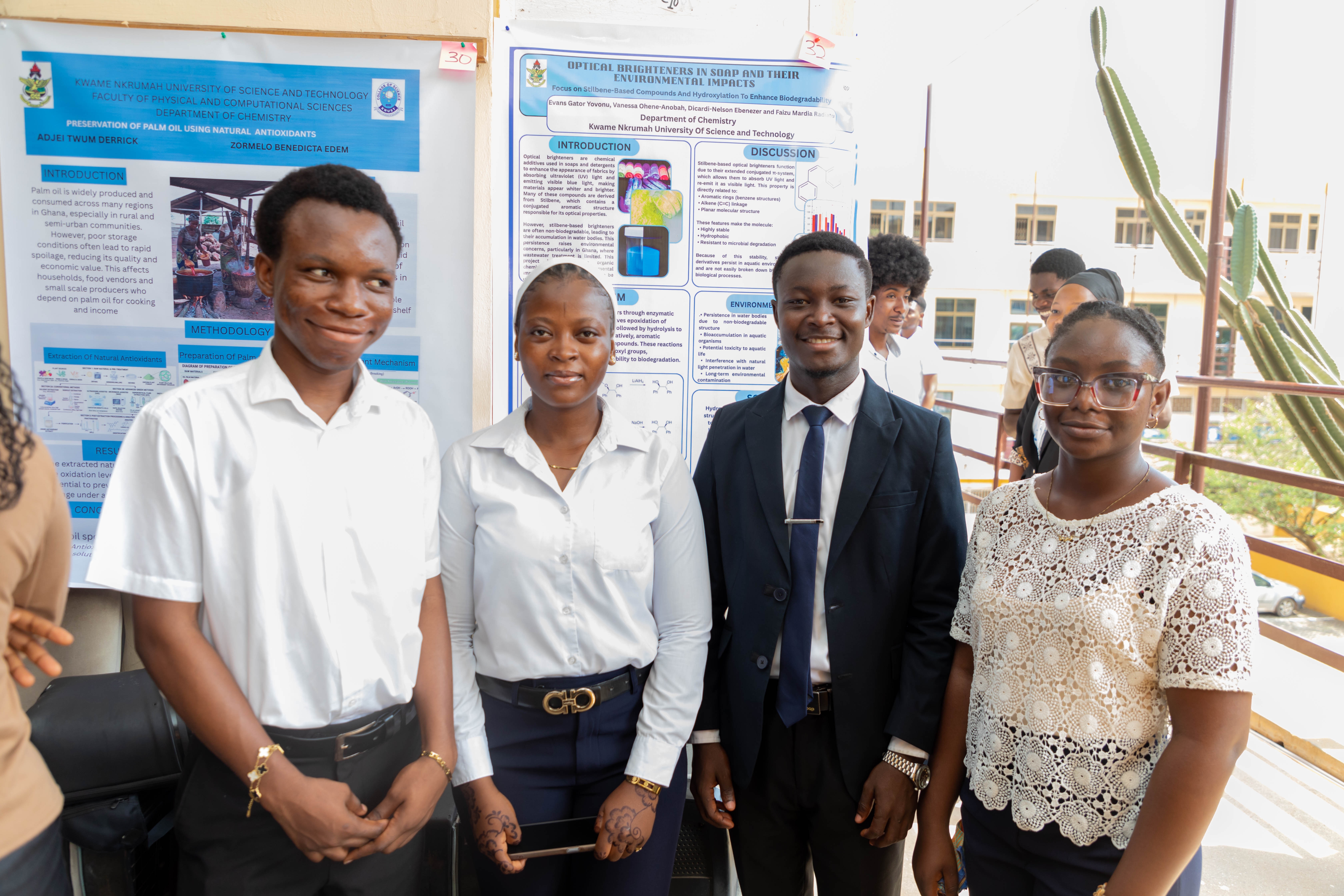
Days before the vacation break, a group of Chemistry students at the College of Science, quietly shifted attention to something familiar yet often overlooked what really happens after detergent disappears down the drain.
Through a poster presentation, Evans Gator Yovonu, Vanessa Ohene-Anobah, Dicardi-Nelson Ebenezer and Faizu Mardia Radiatu explored the science behind optical brighteners, the ingredients responsible for giving clothes that crisp, brighter-than-white finish after washing.
It is the kind of result many people appreciate without a second thought.
Clothes look cleaner, fresher, almost glowing. But as the students explained, that brightness comes with a story that continues beyond the washing line.
Once rinsed away, these substances enter water systems. And unlike many everyday materials, they do not easily break down.
That means they can remain in rivers and other water bodies for a long time, gradually building up and raising concerns about their effect on aquatic life and the wider environment, especially in places where water treatment systems are limited.
Rather than proposing a complicated overhaul, the group focused on a small but meaningful adjustment.
Their idea is simple in principle: make the substance a little more “friendly” to water.
By slightly changing its structure, they suggest it can dissolve more easily and become something that natural processes like microorganisms in water can break down over time.
In essence, it gives nature a better chance to clear it away instead of allowing it to linger.
It is not without compromise. The students acknowledge that this change could reduce, even if slightly, the brightening effect people are used to. But in their view, that is a reasonable trade-off for a safer environment.
Their work reflects a quiet but important shift in thinking, one that places equal value on how well products work and what happens to them after use.
For the students, the takeaway is clear: innovation does not always have to be dramatic, sometimes, it is the small, thoughtful changes that matter most.