As the world marks World Quantum Day, the Mathematical and Computational Physics (MCP) Unit of the Department of Physics at the College of Science, KNUST, under the leadership of Dr. Henry Martin, is celebrating far more than a scientific milestone.
It is a celebration of a growing movement in Quantum Science and Technology (QST) that is shaping teaching, research, and innovation across Ghana and Africa.
Over the past two years, the unit has steadily positioned itself as a key centre for quantum education, skills development, and applied research, ensuring that frontier science is translated into solutions for society.
Building Africa’s Quantum Talent Pipeline
A major highlight has been the E-Learning African International School on Quantum Science and Technology (ELAIS-QST 2024), organized from August 2024 to January 2025 through the KNUST E-Learning Centre.
The six-month intensive school brought together undergraduates, graduate students, national service personnel, master’s students, and professionals from across Africa.
With lectures held at least twice a week, participants explored areas such as quantum algorithms, simulation, machine learning, chemistry, materials, metrology, and computing, guided by both local and international experts.
Building on that momentum, the MCP Unit extended the initiative into 2025 as part of activities leading to the International Year of Quantum Science and Technology.
Through lecture series, mini-projects, and expert-led engagements, the programme equipped young African scientists and professionals with the foundational knowledge needed to contribute to emerging fields in energy, healthcare, advanced materials, and secure communication.
The unit’s commitment to building Africa’s quantum future also reaches beyond the university through GQuantum Education, a pioneering initiative designed for senior high school students.
Through campus experiences, school outreach workshops, live demonstrations, and mentorship opportunities, the programme introduces younger learners to the fascinating principles of quantum science while opening their eyes to future STEM careers.
This early exposure is helping bridge the gap between advanced research and pre-tertiary education, ensuring that the next generation of Ghanaian scientists is prepared for the opportunities of the quantum age.
From Learning to Leadership
In February this year, the MCP Unit further expanded its continental footprint with the African International Conference on Quantum Computing and Simulation (AoC|Q).
The seven-day conference brought together researchers, scientists, and students from across Africa to explore cutting-edge developments in quantum algorithms, simulation of complex systems, and practical applications in healthcare, infrastructure, communication, transportation, and energy systems.
Beyond keynote lectures and hands-on tutorials, the conference also included poster sessions, roundtable discussions, and outreach to senior high schools in Kumasi, reflecting the unit’s belief that quantum science must remain both inclusive and impactful.
From the Tiny World to Tangible Solutions
What makes the MCP Unit’s work especially significant is its strong focus on real-world applications.
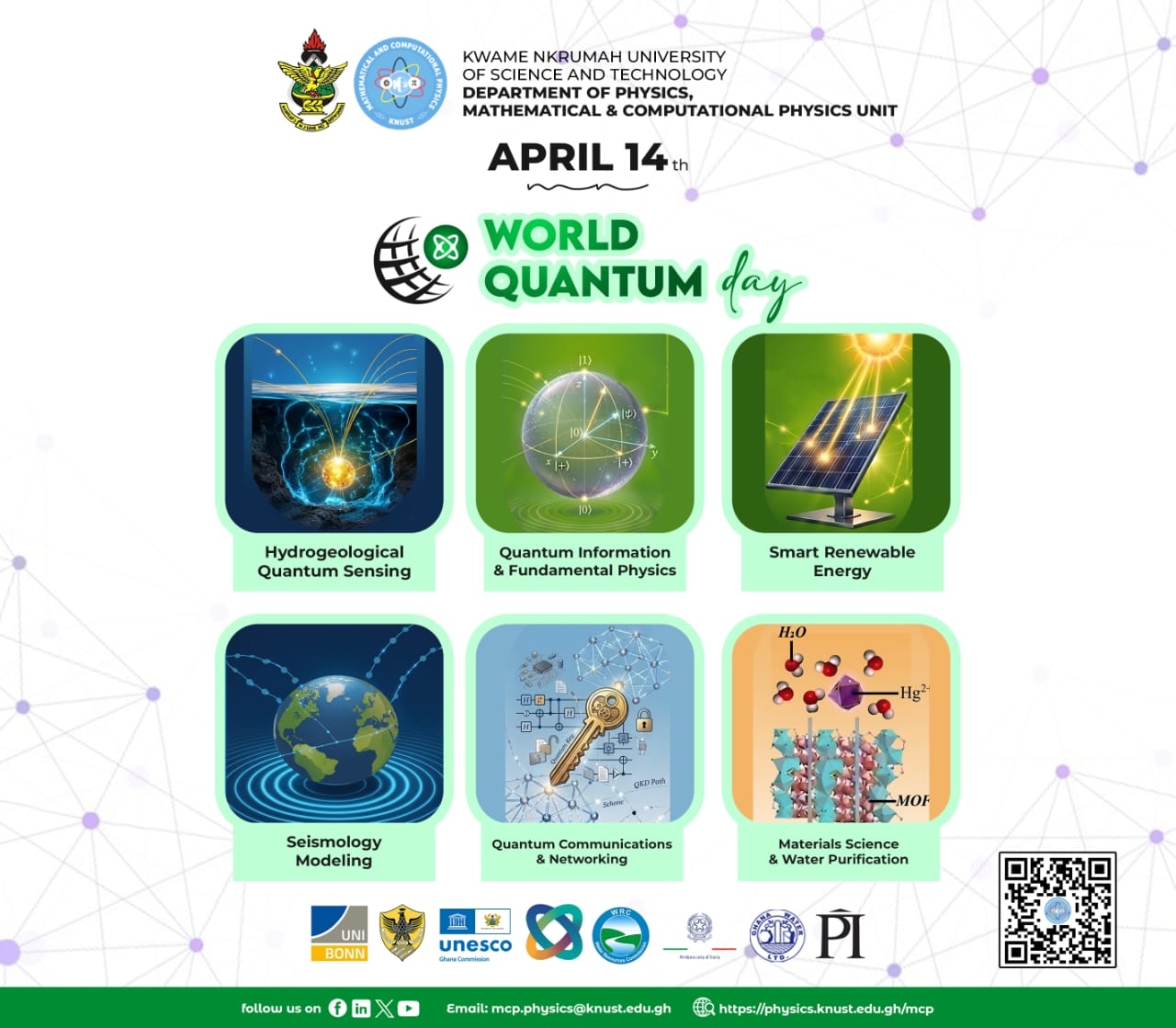
Its research pathways in smart renewable energy, quantum sensing, quantum computing, machine learning, materials modelling, and hydro-geological systems are designed to address pressing challenges such as cleaner energy, safer water, and more efficient technological systems.
From the subatomic world to everyday life, the unit is demonstrating that quantum science is no longer confined to theory. It is becoming a practical tool for innovation and development.
On this World Quantum Day, the MCP Unit’s story is one of vision, leadership, and impact showing how KNUST is not only participating in the global quantum revolution but helping shape Africa’s place within it.
Story by: Edith Asravor