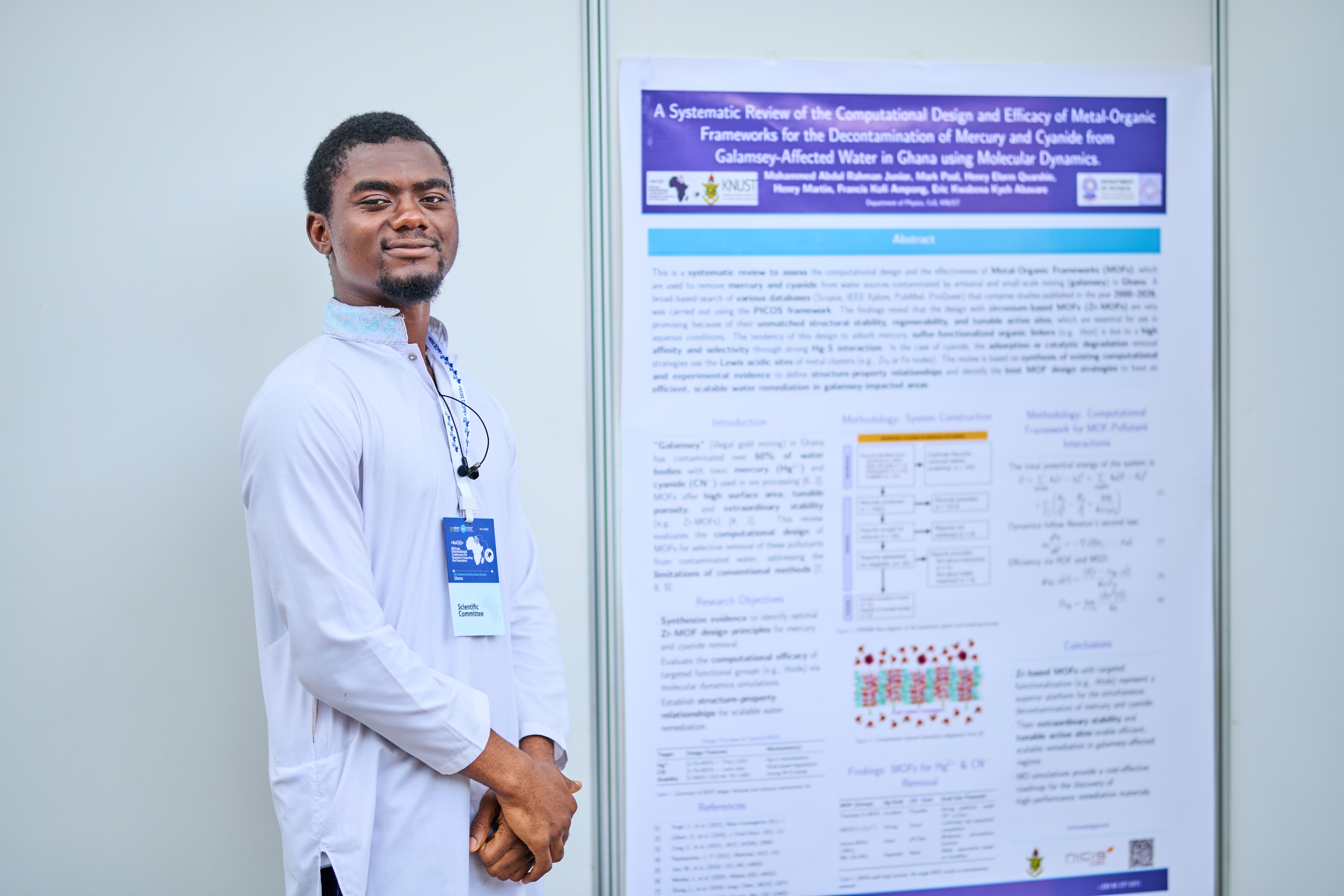
Using computer simulations to study how harmful chemicals move through water, Mohammed Abdul Rahman Junior, an MPhil student at the Department of Physics is exploring how a smart filter material can be designed to trap toxic substances like mercury and cyanide while allowing clean water to pass through.
The idea, inspired by the simple action of a sieve, could offer a practical new way to tackle the growing problem of galamsey pollution in Ghana’s rivers and streams.
At a time when galamsey continues to threaten rivers, farmlands, and livelihoods across Ghana, Abdul’s research offers something many communities desperately need: hope for cleaner water and safer living conditions.
His poster which stood out at the African International Conference on Quantum Computing and Simulation 2026, focuses on finding better ways to remove mercury and cyanide, two highly toxic chemicals often released into water bodies during illegal mining activities.
Explaining the concept in simple terms, Abdul likened the design to an everyday household tool.
“Think of it like a filter or sieve,” he said. “You can design it in different shapes depending on the type of impurity you want to remove. The idea is to let the water pass through but trap the harmful substances.”
That simplicity is what makes the idea so powerful. Much like a kitchen sieve separates flour from lumps, this smart material is designed at a much smaller level to separate dangerous chemicals from water that many communities rely on for drinking, farming, and other daily activities.
The study draws together findings from earlier research to identify the best materials for building these highly selective filters. By using computer-based simulations, Abdul is able to predict which designs are most likely to work effectively before they are physically tested, saving both time and cost.
Beyond the immediate danger to rivers, Abdul stressed that the real threat often spreads quietly through the environment.
When toxic metals seep into the soil, they can eventually make their way into crops and other food sources. The effects may not be seen after the first exposure, but with repeated consumption, the substances gradually build up in the body.
“It becomes bioaccumulative,” Abdul explained. “Nothing may happen after the first time, but over time it accumulates and can lead to serious health problems, including neurological issues.”
This is what gives the research its wider significance. It is not only about cleaning polluted water bodies, but also about protecting food systems, safeguarding public health, and reducing long-term risks for entire communities.
By presenting this work at an international conference on quantum computing and simulation, Abdul also demonstrated how advanced digital tools can help solve urgent environmental problems facing Ghana today.
Rather than relying only on trial and error in the laboratory, simulation allows researchers to test ideas faster and identify the most promising solutions.
The project highlights how KNUST research continues to turn scientific innovation into practical answers for society using advanced tools to help save rivers, protect lives, and restore hope for communities affected by galamsey pollution.
Story by: Edith Asravor